Showing posts with label healing. Show all posts

Tuesday, November 15, 2011

Great New Drug Discovery, Prevents Cancer Too

A recent study reports that over 75 percent of advanced cancer patients have low levels of Vitamin D.  Read about it here. The lowest levels of Vitamin D are associated with the most advanced cancers.

Vitamin D has become the new wonder drug. Vitamin D deficiency is implicated in Multiple Sclerosis. Flu season is the season when our sunlight deficiency causes a drop in our Vitamin D levels and a corresponding drop in the health of our immune systems.  Moderate to high doses may reduce heart disease, and can slow the progress of congestive heart failure. Of course we have known for years that Vitamin D deficiency causes as loss of bone density progressing to rickets.  Vitamin D is a commonly recommended preventative for osteoporosis. Vitamin D is now being studied for diabetes because it decreases insulin resistance - a benefit for diabetics.

What's wrong with this picture?  It hi-lights some serious deficiencies in our medical paradigm.  We need a health paradigm. 

1. Vitamin D is a nutrient. Not a drug. It is studied as it if was a drug.


2. The main natural source of Vitamin D is sunshine. But people who sell sunscreen have built a huge propaganda message against sunshine - so many doctors are reluctant to prescribe sunshine to prevent disease.  Fewer are likely to recommend sunshine for health. I have read - but not seen specific studies - that melanomas do NOT develop on areas of our skin that receive the most sun - the face and hands. Research published in the British Journal of Dermatology concluded that the perceived statistical increase in melanomas is most likely due to a shift in diagnoses which classify non-malignant lesions as cancerous. And countries near the equator,where the sun is strongest - tend to have lowest incidences of skin cancer. What's up with that? Here's Mercola's post on this item - the comments are interesting as well.

The wind is my drug - and now the sun as well. 


3. We have clearly documented measurements of 'the amount of Vitamin D required to prevent illness'.  Of course these numbers are being revised in light of new findings.  But we have no recommendations, and no studies, of the amount of Vitamin D consumption (or creation via exposure to sunlight) that will optimize health. We only research for the 'minimum to prevent disease' and then we measure drug like effects when Vitamin D is used to treat disease.

4. You can be deficient in Vitamin D.  Deficiency in Vitamin D means that you are consuming, or producing through exposure to sunlight, less than the RDA of Vitamin D.  You can be preficient in Vitamin D.  Preficiency exists when your Vitamin D levels are below the 'optimal' level of Vitamin D. But we do not know the optimal levels of Vitamin D.  There are no studies to measure the optimal intake, or even optimal range, of any nutrient. So, we don't know what amount of Vitamin D is most healthy. And we don't know what amount of sunshine is most healthy.

5. Vitamin D affects your health. But we don't study health, we only study illness. How Vitamin D affects your health is poorly studied - and recent studies of Vitamin D are all focused on illness, not on health.

This might explain why the information about Vitamin D has remained hidden from view for so long. We are now starting to study Vitamin D deficiency more often, but we do not yet study Vitamin D preficiency, nor Vitamin D health. It also makes me wonder what other nutrient imbalances hold keys to illness - that we don't understand because we don't study health.

6. Vitamin D is studied in isolation. All nutrients tend to be studied, as if  they are drugs, in isolation. When we learn to measure health, and to determine the correct amounts of nutrients for optimal health - we will learn about combinations of nutrients and how they affect health.  Studies to date on multi-vitamin supplements, for example, treat each multi-vitamin recipe as a drug, and measure results as if they were drugs.  Effects on health are not measured, because we don't measure health effectively. Only effects on illness are measured.

In theory, we should be able to:

a) Measure the health level of a person and the changes over a span of time, along many of the dimensions in the hierarchy of health.  At present there are no established techniques to effectively measure and compare the health of so called 'healthy' individuals.

b) Measure the nutrient intake and changes in nutrient intake of the same person over the same span of time.  It is very easy for our intake of nutrients to drift over time, without us being aware.  We seldom evaluate diets - and are less likely to evaluate diets for overall nutrient content.  Instead, diets are evaluated for factors that do not contribute directly to health - but might contribute to illness - calories, unhealthy fats, etc.

c) Analyze the relationships between nutrient intake, changes in nutrient intake, and health.

Instead, we measure when illness is found. We deliberately wait until something breaks, and then try to fix it, or try to figure out how to prevent it from breaking, without understanding

Your body is always growing, healing, repairing, working to improve your health.  Working to restore health imbalances. Every person has a different level of health, different health strengths and weaknesses. But none of us have a clear idea what our individual strengths and weaknesses are.  Which of the over 100 essential nutrients are in your diet in healthy amounts?  What types of exercise are most healthy for your personal body?

Frankly, we don't know much about health. Hopefully we can start learning. You have a right to life, liberty and the pursuit of healthiness.

Yours in health, tracy
Tracy is the author of two book about healthicine: 


Personal Health Freedom 

Friday, October 28, 2011

Primary Illness and direct causes of illness

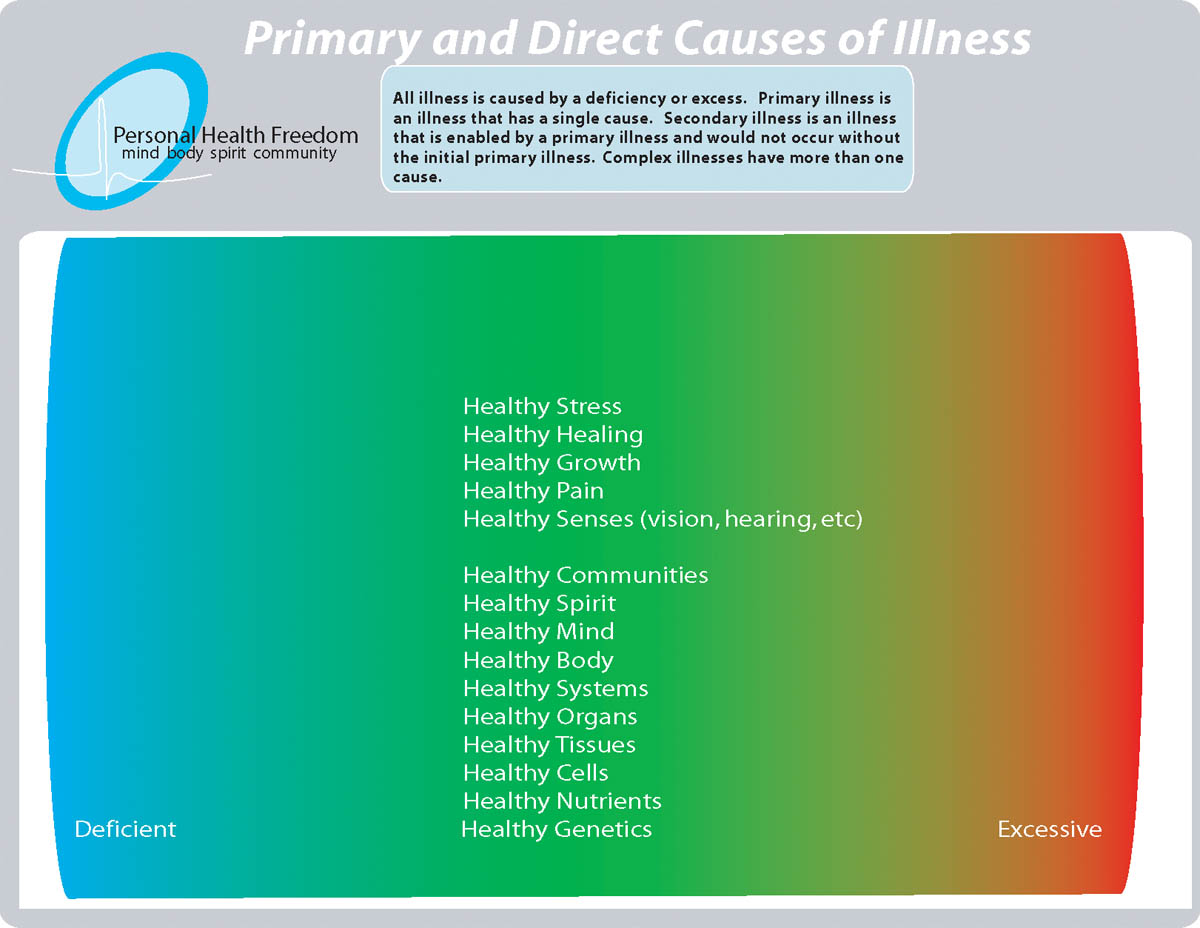
View Diagram full Size

Some illnesses are complex, the result of multiple causes. However, many are simple or trivial to understand, although they might not be trivial to treat or cure. Simple, or primary illnesses are those that have a single cause. The value in understanding these illnesses is in our ability to prevent them, once we understand the cause.

Secondary illnesses are illnesses that have sequential causes.  Complex illnesses are those that have multiple causes.

The basic primary illnesses flow right out of the hierarchy of health.  Because each of the layers in the hierarchy is dependent on the health of the layer below, a health deficiency, or excess in one layer can cause an illness in a higher layers, in other components of the same layer - and even, in exceptional circumstances in layers below.

So, the first list of primary causes of illness is the list of components in the hierarchy of health: genetics, nutrients, cells, tissues, organs, systems, body, mind, spirit and community - in deficiency or excess.

If this list seems short, remember that nutrition alone has over 100 components that are critical to health. We don't have a comprehensive list for nutrients. Nor do we have a comprehensive list for cells, when we recognize that some of the cells essential to health are bacteria that contribute to health.

A specific deficiency in nutrition might cause scurvy - which affects cells, bones, organs and systems, but only when it becomes severe.  Before that point, it is just a deficiency.

Technically, an illness is something that can be diagnosed, and sometimes treated. A simple excess or deficiency might not be sufficient to cause an illness.  There must be significant severity, and possibly duration, for an illness to develop and be diagnosed.

To this list, we can add other deficiencies and excesses.  A deficiency, or excess of growth can lead directly to illness.  There may be a 'deeper cause' of the growth deficiency or excess, making the illness a 'secondary illness', caused by one health issue, which caused another health issue. However, if the excess growth leads directly to the illness - it can be classified as a direct cause of illness, even it it is not the primary cause. In this case, the illness does not have a primary cause.

A primary cause of illness exists when a single deficiency or excess is the only cause of an illness. Vitamin C deficiency is the primary cause of scurvy.  A bullet in the shoulder can be the primary cause of a flesh wound.

A direct cause of illness exists when a single deficiency or excess is directly responsible for the illness. If that cause had prevented, or removed removed in time, the illness would not have occurred.

All primary causes of illness are direct causes of illness. Direct causes are not necessarily primary causes.

Can we create a list that categorizes all primary causes of illness? All direct causes of illness?  I don't know, but I have created a list that covers a majority.  I'll be happy to add to the list if you can tell me something I've missed.

Each individual cause of illness, primary, direct, or secondary is the deficiencies and excesses of some component of health. To the list of health components from the hierarchy of health, we should add:

The six senses: vision, hearing, touch, smell, taste and balance. A deficiency or excess of any of these senses may indicate illness and may cause further illnesses.

Pain: a deficiency or excessive ability to feel pain may indicate illness and may cause further illnesses.

Growth: a deficiency or excess of growth may indicate illness and may cause further illnesses.

Healing: a deficiency or excess of healing which includes the immune system, repair systems and growth systems may indicate illness and may cause further illnesses.

Stress: a deficiency or excess of stress may indicate illness and may cause further illnesses.

Like the components of health, each of these causes of illnesses is necessary to health. Illness appears when they are deficient, or when they are in excess.

With any illness, if we can clearly identify a single direct cause, we can work directly to prevent and possibly to cure the illness.

Primary prevention (or direct prevention) of illness is an action that directly tackles the primary causes of illness.   This is a fundamental health concept of prevention.

However, take care when reading the latest health news.  You might read that red wine has been shown in statistical studies to prevent heart disease.  Ask yourself, is this a primary prevention?  Does it prevent specific types of heart disease - those caused by a deficiency of red wine, in every case?  If so, then it is a primary preventative. If not - it is a statistically possible preventative but not a primary preventative.

This important concept, of primary, or direct illness, and primary or direct preventatives is very powerful.  If we have a primary preventative - then searching health for the hint of an illness - before a full blown illness develops, might be combined with the preventative to eliminate cases of the illness.

This can be especially effective for any illness where a cause results in minor health issues in the short term - but serious issues in the long term.

At present, we tend to focus our 'health' care on diagnosed illness, not on health.  So we tend to ignore causes that take a long time to develop into a diagnosed illness.  I'm not discussing 'cancers caused by smoking'.  Rather, I'm wondering what illness might be caused by a low level deficiency of a single nutrient, or a combination of nutrients - when the deficiency exists for years or decades.

We need a better understanding, and better studies of primary illnesses and direct illness so we can learn more about health - and how to improve health.  With this understanding we might learn the causes of some illnesses that are mysteries today.

Yours in health,
tracy
Tracy is the author of two book about healthicine: 


www.personalhealthfreedom.com